The Mid-Year Board Meeting: Run It Off One Page
Halfway through a July to June year? How to run the board's mid-year fundraising review off one page, and what to do when a number is behind.
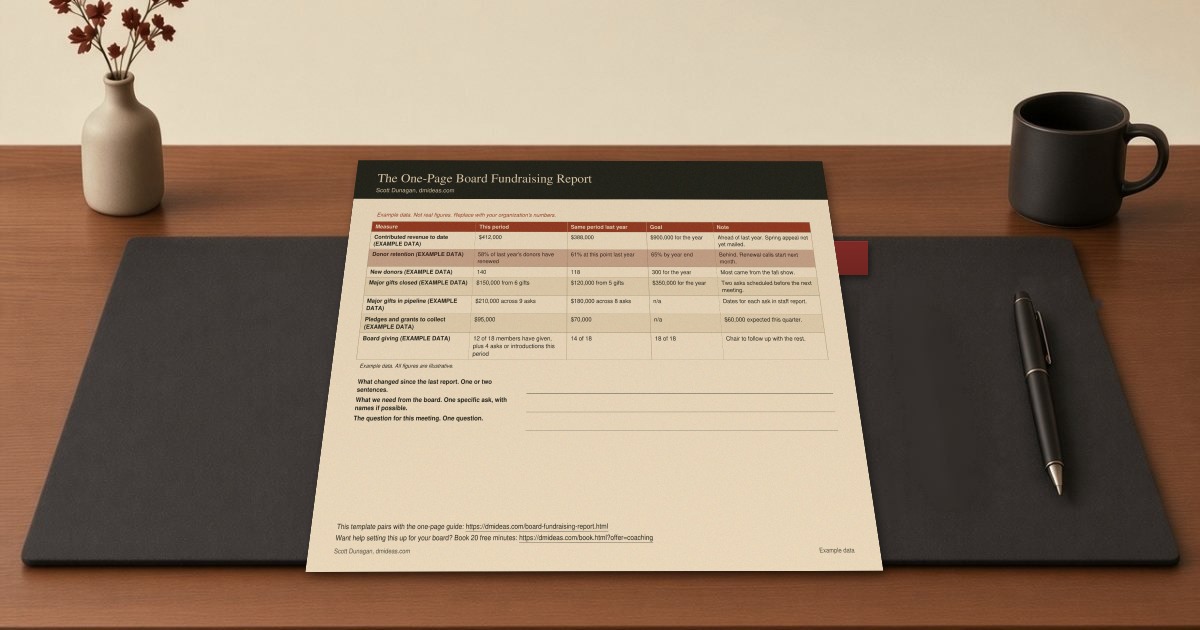
If your fiscal year runs July to June, the December or January board meeting is your halfway review. Send the one-page fundraising report ahead of it, read it top to bottom in the room, ask one question at each line, and close on one ask for the next six months.
The page itself is here: the one-page board fundraising report. You can also download the PDF and bring it to the meeting. On a calendar year? The same meeting works as your year-end review.
Why does the mid-year board meeting matter?
Half the year is left. That is enough time to change the result.
By the spring meeting, most of the year is already booked. By June, the board can only explain the gap. The halfway meeting is the last one where the board can still do something about it.
The one page keeps that meeting on decisions instead of activity. I've already covered what goes on the page and what to cut. This piece is about what to do with it once it's in front of the board.
The development committee chair presents. The development director is in the room to answer questions. Five minutes, because the board already read it.
What should a board ask about the fundraising report?
Read the page in the order it's printed, the same order every meeting. Hold the PDF next to this and follow along. One thing to look at, one question to ask.
Contributed revenue against goal
At mid-year, look at pace, not the total. Where are we against the goal, and against this same point last year?
Ask: "If the second half looks like the first half, where do we finish?"
Donor retention
Look at who gave last year and hasn't given again yet. That list is the cheapest money left in the year. (On timing that ask, see the year-end ask after the renewal.)
Ask: "Who on the not-yet-renewed list should hear from a board member before the fiscal year closes?"
New donors
Look at where they came from. One source usually did most of the work.
Ask: "Can we run that again before June?"
Major gifts closed and in the pipeline
Look at how much of the second half rides on a few asks. Every open ask needs a date and an owner.
Ask: "Which open asks have no date, and which have no board member on them?"
Pledges and grants still to collect
Look at what is promised and when it lands. A pledge counted when it's signed and again when it's paid makes the gap look smaller than it is.
Ask: "What lands before June 30, and what slips into next year?"
Board giving and board asks
Look at who hasn't given yet this year, and who has made an ask or an introduction.
Ask: "Who follows up with the members who haven't given, and by when?"
The three lines under the table
What changed since the last report. What we need from the board. The question for this meeting.
At mid-year, those three lines are the meeting. The six numbers tell the board where it stands. The three lines tell it what to do. If a number is behind, the third line is where you say so.
What do you do when fundraising is behind goal halfway through the year?
Say it early. Say it plainly. A number that's behind in January is a plan problem. In June it's a budget problem.
Whose job is it when the board misses its fundraising goal?
Both, but different parts. Staff run the program and own the plan. The board owns three things: its own giving, its asks and introductions, and the decision on whether the goal or the budget changes.
Nobody needs to be blamed. Everyone needs to know which part is theirs.
What should the board do in the next six months?
Keep it to what a board member can actually do. Tie each move to a line on the page.
- Retention behind: each member makes a set number of renewal calls to last year's donors before the spring meeting.
- Major gifts behind: put a board member on every open ask that doesn't have one, and set the date.
- Board giving behind: the chair closes out the members who haven't given, by a date the board agrees on.
- New donors behind: each member brings staff one introduction before spring.
That's the list. More moves mean less follow-through.
Should the board reset the goal or hold it?
Hold the goal when the gap has a plan and a name next to it. Reset it when closing the gap depends on gifts nobody has asked for yet.
Either way, decide it at this meeting, not in June. If the goal moves, the budget moves with it, and the board should treat that like any other spending decision. The questions are the same ones in what a board should ask before it approves the marketing budget.
How should the meeting end?
With one ask, with names. Not "any questions?"
Something like this: "Retention is the number that's behind. Staff pulled the list of last year's donors who haven't given yet. I need eight of us to take five calls each before the March meeting. Hands up now, and the lists go out tomorrow."
Then write down who said yes. That list is the first thing on the page at the next meeting.
The page gets you into the room. The questions get you to a decision. The ask gets you the second half of the year.
Setting up the report and the review with your board is part of my consulting work.
If your mid-year meeting is on the calendar, book 20 free minutes. We'll go through your one page and the ask I'd close on. No pitch.